
Inequality in work-life balance costs the Spanish economy more than 95 billion euros per year
- The second report ‘Opportunity cost of the gender gap in work-life balance’ by the ClosinGap Association, led by Repsol, quantifies the economic impact of gender inequality in work-life balance: 6.4% of GDP in 2023, compared to 8.9% reflected in the first report published in 2019.
- 65% of the economic cost of the work-life balance gap comes from the unequal distribution of childcare and dependent care.
- The report highlights the improvements achieved, but points to a possible stagnation among Generation Z and calls for strengthening co-responsibility in caregiving.
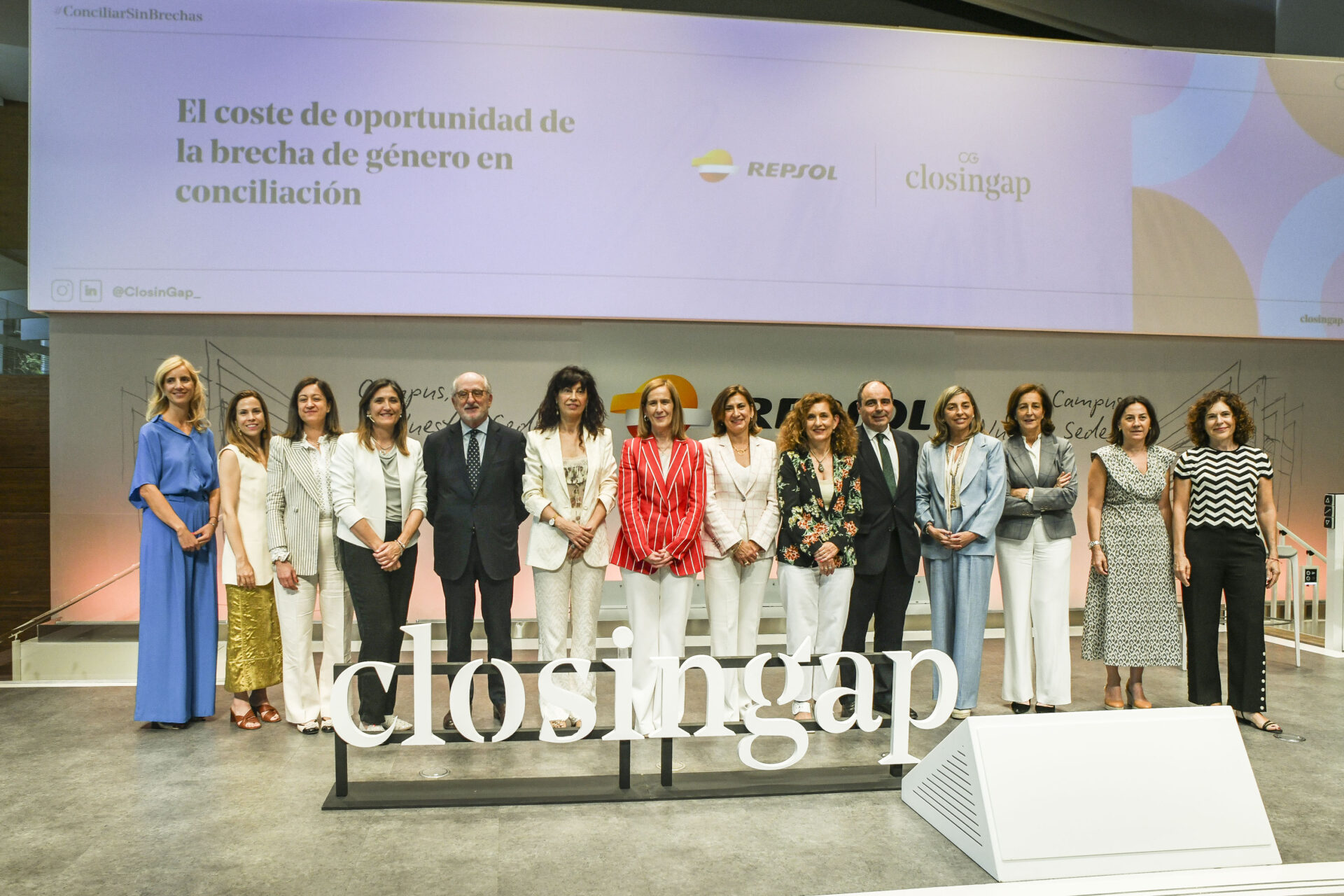
Madrid, June 17, 2025 – The lack of shared responsibility in the home and in family care continues to have a considerable impact on the Spanish economy. This is according to the second report, “Opportunity Cost of the Gender Gap in Work-Life Balance,” commissioned by Repsol and prepared by Afi for the ClosinGap Association, which estimates the economic cost of this gap at €95.581 billion annually, equivalent to 6.4% of 2023 GDP.
The study analyzes the distribution of time spent on domestic and caregiving tasks between men and women, and concludes that working-age women dedicate 41 million more hours per day to these activities than men. This unpaid burden limits their labor force participation, professional development, and physical and emotional well-being, and negatively impacts the economy by wasting a substantial portion of available talent.
As the Minister for Equality, Ana Redondo, emphasized at the closing of the study’s presentation, “it is very important to have these kinds of reports because the data helps us see what works and what doesn’t. And the ClosinGap report, commissioned by Repsol, shows that what isn’t working is the care gap. Men should be joining the caregiving workforce as naturally as women have entered the workforce. If we want a fairer, more equal, and happier society, we must move towards genuine co-responsibility. And we need the collaboration of all stakeholders: individuals, families, businesses, and, of course, government.”
The data shows that this inequality is particularly concentrated in caregiving: two-thirds of the total cost is associated with the care of children and dependents, a responsibility that continues to fall primarily on women. In total, they dedicate 3.2 hours more per day than men to these tasks, which is equivalent to 2.8 additional full working days each week.
Marieta Jiménez, president of ClosinGap, emphasized in her speech that she firmly believes that work-life balance is not a luxury or a concession. It is a courageous decision towards a smarter, more humane model, more aligned with life. And it is in our hands to make it a reality.
Generation Z faces the risk of reproducing traditional roles
The report also addresses the intergenerational evolution of shared responsibility. Millennial men have significantly reduced the gap in housework compared to baby boomers: they currently dedicate only 4% less time than needed to achieve equality, compared to the 31% difference recorded two decades ago. However, this improvement does not extend to the area of caregiving, where the differences remain virtually unchanged.
According to Carmen Muñoz, Repsol’s Director General of People and Organization, “the study points to a worrying paradox regarding Generation Z: although this generation expresses more favorable attitudes towards equality, gender stereotypes persist in practice, especially in the care of the elderly. This disconnect between discourse and practice reveals a risk of regression if the structural factors that perpetuate these inequalities are not addressed.”
Direct impact on the labor market
The report also focuses on how the lack of effective work-life balance directly impacts the labor market. Women continue to face greater obstacles to equal participation: they are more likely to work part-time, interrupt their careers, or forgo opportunities for advancement.
According to the study, 92% of leaves of absence for childcare or care of family members are requested by women, and 84% of reduced working hours for caregiving also fall on them. This unequal distribution has cumulative effects on their career paths, salary levels, and future pensions.
Furthermore, it is estimated that reduced working hours due to work-life balance issues represent a potential loss of 1.4% of national GDP, which translates to approximately €19 billion that the economy fails to generate. This is compounded by the effect of inflexible work structures, such as split shifts, which particularly hinder work-life balance for women, reinforcing a model that penalizes female employment and exacerbates the gender gap in access to and retention in the labor market.
Key measures from the home, the company and public policies
To address this situation, the study proposes a series of measures. In the business sector, it recommends moving towards flexible work models, performance-based evaluations, and gender-neutral work-life balance policies. In the public sector, it advocates for strengthening care services, expanding early childhood education (ages 0-3), and guaranteeing shared parental leave that is effectively used by both parents.
The report also underlines the importance of promoting a cultural change in households, with more education on equality from an early age, awareness campaigns and making visible the mental load that many women continue to assume in the daily organization of the home and care.
In short, the report indicates that the gender gap in work-life balance not only persists but also carries a high economic and social cost. Despite legislative advances and some cultural evolution, the unequal distribution of time and responsibilities in the domestic sphere continues to penalize women. In addition to limiting their well-being, health, and economic autonomy, this imbalance also reduces their effective participation in the labor market and contributes to time poverty, a phenomenon that restricts their personal and professional development.