Closing the gender gap in the energy transition could contribute €122 billion annually to Spain’s GDP.
- The new ClosinGap report reveals that only one in four people working in energy transition sectors is a woman. It warns that, at the current rate, parity will not be achieved until at least 2061.
- The study, commissioned by Enagás, suggests that equalizing the presence of women and men in the sector could increase Spain’s GDP by 7.7%.
The energy transition is key to combating the climate crisis and fostering economic competitiveness, and it also presents an opportunity to advance gender equality. This is the conclusion of the ClosinGap report, “Opportunity Cost of the Gender Gap in the Energy Transition,” commissioned by Enagás and presented today, which analyzes how the underrepresentation of women poses a significant obstacle to fair, equitable, and competitive development.
The study, prepared by Afi, quantifies for the first time the economic impact of the gender gap in sectors linked to the energy transition: if parity were achieved, Spain’s GDP could increase by 122 billion euros annually, equivalent to 7.7% of the national GDP in 2024. The report shows that female talent, key to the success of the energy transition, remains underutilized in strategic sectors of the future.
In the words of Judit Carreras, Director of the Just Transition Institute, “Reports like this are key to understanding that the energy transition is not only technological or climate-related, but also a lever for quality employment and for moving towards a fairer society. We observe that the greater the ambition in gender equality, the faster the convergence and the greater the positive impact on the economy and collective well-being.”
As Arturo Gonzalo, CEO of Enagás, pointed out during the presentation, “Behind every statistic in this report are people, talent, and opportunities that we cannot afford to lose. Equality cannot wait, and the purpose of this research is to inform action. Measuring gender inequality and its consequences is the way to firmly adopt the appropriate policies and measures.”
Regarding the progress made by Enagás, Arturo Gonzalo pointed out that “diversity and inclusion is a key pillar of our strategy and we translate this commitment into concrete policies and actions: we have 50% women on our Executive Committee and 40% on the Board of Directors, as well as in management and pre-management positions.”
Marieta Jiménez, President of ClosinGap, emphasized that “the report is, above all, an invitation. To look at things with perspective. To work with urgency. To design the energy transition based on the conviction that equality is not an add-on, but an essential condition for progress. If we manage to bring together all voices—those of today and those of tomorrow—we will ensure that the energy that powers the country is also the energy that closes gaps, generates opportunities, and builds a more prosperous society for everyone.”
Action proposals: equality as an economic and social driver
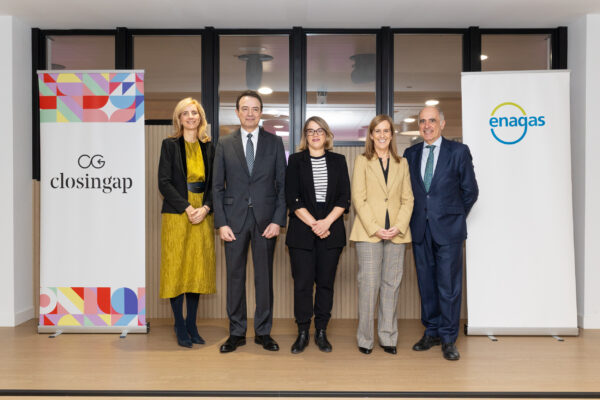
The panel discussion presenting the ClosinGap report—moderated by Javier Perera, Director General of People and Transformation at Enagás, and featuring Natalia Latorre, Director General of Energy Transition at the company, Pedro Fresco, Director General of AVAESEN, and Isabel Reija, Independent Advisor and Dean of the ICAI College of Engineers—concluded that ensuring equality in the energy transition is not only a matter of social justice, but also a strategic priority to maximize the country’s competitiveness and economic development.
The report —presented by the Director of People and Diversity at Enagás, Susana Toril, and by the General Director of ClosinGap, Lucila García— makes it clear that reducing the gender gap would not only contribute to equality, but would also represent a significant qualitative leap in growth, innovation and sustainability for the Spanish economy.
Along these lines, the document details a package of proposals to facilitate women’s entry into the sector, ranging from specific incentives in training and selection, visibility campaigns and female role models, to improvements in the monitoring and evaluation of equality policies. It also advocates for the automation of access to aid to combat energy poverty and better statistical monitoring of gender gaps.
Structural inequality despite educational progress
The report reveals that, despite representing 38% of university-educated employees in the sector, women hold only 24% of total jobs related to the energy transition, with a significant presence in lower-paying and administrative roles, and limited participation in technical, operational, and leadership positions. This gap persists across generations: newer cohorts show progress in education, but not in access to technical jobs or positions of responsibility.
Also noteworthy is the low representation of women in both vocational training programs linked to the sector and STEM university degrees, which limits women’s access to emerging green job opportunities. Only 11% of women graduating in related fields manage to find employment in the sector, compared to 23% of men.
The labor gap: a double challenge and an opportunity for transformation
The sector’s better working conditions—with less temporary employment and smaller wage gaps than in the broader economy—have not been enough to close the gender gap. The well-known “glass ceiling” continues to limit women’s access to senior management: only 22% of management positions in the sector are held by women. Furthermore, talent retention remains a challenge; women dedicate a smaller percentage of their working lives to these sectors compared to men.
The document also highlights one of the least visible aspects: energy poverty affects households headed by women more intensely, especially single mothers and pensioners, generating greater health risks, an overload of care and limitations in access to basic rights as energy consumers.
Women are leading the social and environmental commitment to the energy transition
According to the CIS Barometer (March 2025), concern and commitment to climate action is significantly higher among women, especially among younger generations, where more than 94% of Generation Z women consider the energy transition an opportunity for business development and innovation.
According to the study’s projections, if current trends continue, gender parity in the energy transition sector will not be achieved until 2061. Even with proactive policies, full equality will not be reached before 2043. Only a radical shift, in line with international goals (equality by 2030), would allow for accelerating the closing of the gap, which would require increasing the female presence in the sector at a rate five times higher than current rates.